Accuracy of volumetric modulated arc radiotherapy of the thoracic region based on HyperSight imager
DOI:
https://doi.org/10.17532/jhsci.2026.3054Keywords:
Cone-beam computed tomography, HyperSight, relative electron density, volumetric modulated arc therapy, dosimetry, adaptive radiotherapyAbstract
Introduction: This study evaluated the accuracy of various cone-beam computed tomography (CBCT) reconstruction modalities, specifically the HyperSight (HS) detector, in comparison to standard computed tomography (CT) simulation for potential use in online adaptive radiotherapy. The research focused on the Hounsfield Unit (HU) to relative electron density (RED) conversion and its subsequent impact on volumetric modulated arc therapy (VMAT) dose calculations.
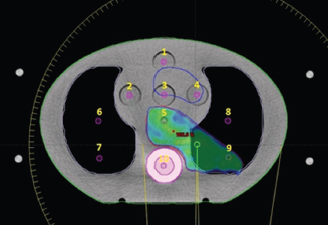
Methods: Two tissue-equivalent phantoms, the advanced electron density and the CIRS Thorax phantom, were utilized. Imaging was performed on a SOMATOM go.Open Pro CT simulator and a Varian TrueBeam medical linear accelerator using CBCT, HS-CBCT, HS-iterative CBCT (iCBCT) and HS-iCBCT metal artifact reduction protocols. Calibration curves (HU-RED) were generated for two regions: RED <1.2 and 1.2≤ RED <1.8. VMAT plans (6 MV) were created in the Eclipse 18.1 treatment planning system (TPS), using an anisotropic analytical algorithm (AAA) and Acuros XB algorithm. Absolute dose measurements were conducted using an SNC125c ionization chamber and compared with TPS-calculated doses.
Results: In the soft-tissue region (RED <1.2), all imaging modalities showed an excellent linear correlation with CT (r > 0.998), with HU deviations within ± 30 HU. In the high-density region (1.2 ≤ RED < 1.8), HS-CBCT demonstrated superior stability with the lowest root mean square error, 62.88 HU. Dosimetric results showed that 96.7% of all measurement points met the ± 3–4% agreement criteria. For the AAA algorithm, HS-iCBCT exhibited the highest precision (standard deviation = 0.59) and the lowest mean absolute error. The Friedman test confirmed a statistically significant difference between modalities (p < 0.05), with HS-iCBCT showing the most consistent performance.
Conclusion: Both HS-CBCT and HS-iCBCT provide highly accurate HU-RED conversions and reliable dosimetric results for RED < 1.8.
Downloads
Downloads
Published
License
Copyright (c) 2026 Goran Kolarević, Tatjana Ignjatić, Dejan Ignjatić, Elena Omerović, Marija Brkić, Amel Kamenjaš, Samir Karamujić, Dejan Ćazić, Aleksandar Kostovski, Goran Marošević

This work is licensed under a Creative Commons Attribution 4.0 International License.