Associations of Irisin and visceral adiposity index with cardiometabolic risk and their predictive value in Jordanian adults: A cross-sectional study
DOI:
https://doi.org/10.17532/jhsci.2026.2932Keywords:
Irisin, cardiometabolic risk, diabesity, visceral adiposity index, obesity indicesAbstract
Introduction: Irisin affects obesity and cardiometabolic syndrome (CMS) risk factors, but its precise mechanism and relationship with visceral adiposity index (VAI) remain unclear. The aim of this research is to explore the associations between circulating irisin, VAI, obesity indices, and cardiometabolic risk, and to test their predictive values.
Methods: This cross-sectional study included a systematic random sample of 300 Jordanian adults, aged 19-65 years, comprising 100 obese individuals with Type 2 diabetes mellitus (T2D) (G1), 100 obese individuals without T2D (G2),
and 100 normal-weight non-diabetics (G3), with a 1:1 sex ratio. Standard protocols were followed to measure waist circumference (WC), hip circumference (HC), waist-to-hip ratio (WHpR), waist-to-height ratio (WHtR), and body mass index (BMI), along with circulating irisin, fasting blood glucose (FBG), lipid profile, and VAI. Multivariate analysis, receiver operating characteristic curves, and area under the curve (AUC) were used for comparing the CMS risk predictive value.
Results: Irrespective of sex, irisin (ng/mL) was significantly lower (p < 0.01) in G1 (136.62) compared to G2 (234.40) and G3 (299.27). VAI was highest (p < 0.01) in G1 (7.54) compared to G2 (6.15) and G3 (6.15). BMI, WC, WHpR, and
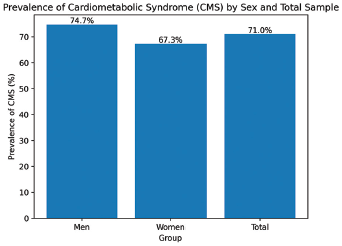
WHtR negatively correlated (p < 0.01) with irisin. BMI and irisin did not correlate with VAI, which positively correlated (p < 0.05) with WC, WHtR, WHpR, FBG, and triglycerides. WC had the highest AUC (0.781), followed by BMI (0.775), irisin (0.770), WHtR (0.748), WHpR (0.717), and VAI, having the lowest (0.679). FBG and BMI increased CMS odds; irisin was inversely related to CMS.
Conclusion: Irisin may serve as a promising biomarker for predicting CMS risk, whereas VAI appears to be the weakest predictor among obesity indices.
Downloads
Downloads
Published
License
Copyright (c) 2026 Dalia Abu Al-Haija'a, Mousa Numan Ahmad

This work is licensed under a Creative Commons Attribution 4.0 International License.